
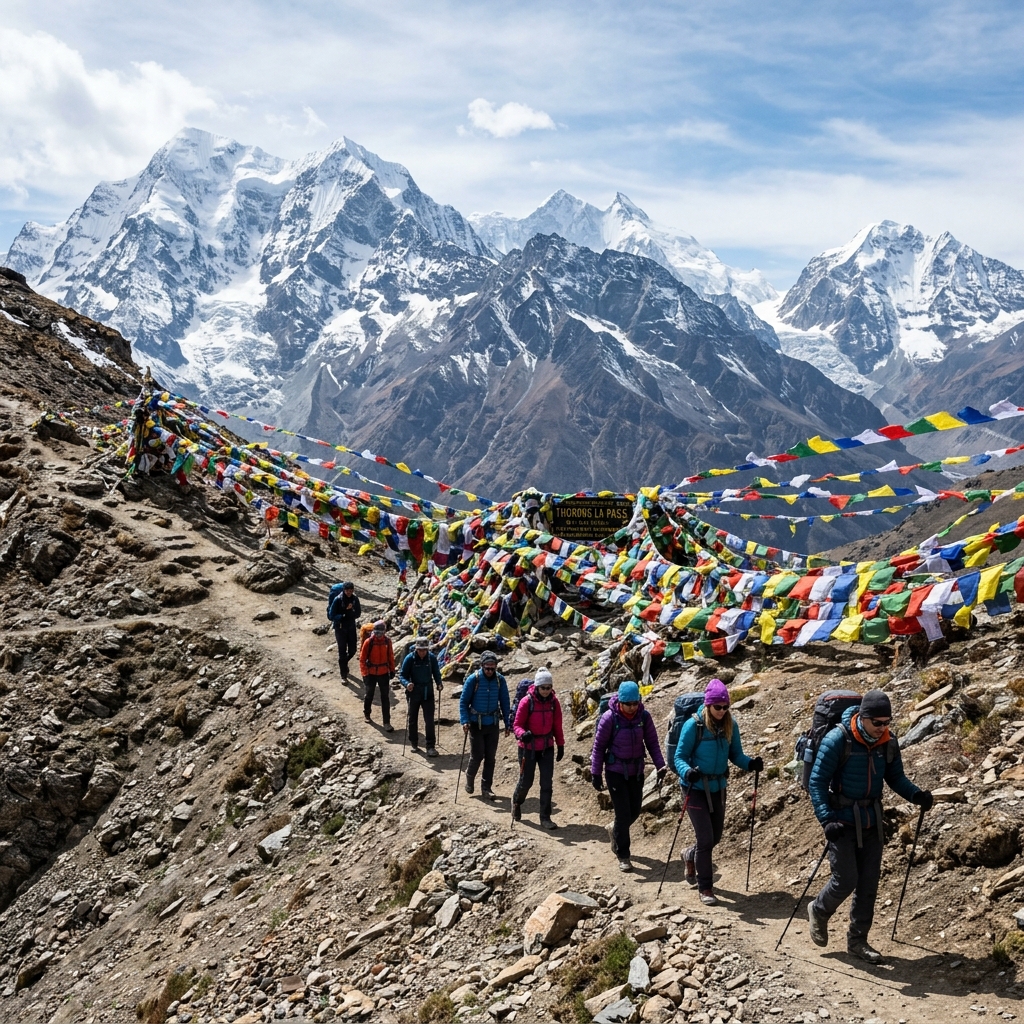
At 4,600 metres, the sky can turn from postcard-blue to whiteout in under an hour. This is the story of a group of eight trekkers who nearly crossed Thorong La into exactly that kind of storm — and the single decision that changed everything.
- A guided group departed High Camp (4,833 m) at 5:00 AM under clear skies
- Weather deteriorated sharply near the pass; visibility dropped to a few metres
- The lead guide made the call to turn back rather than push for the summit
- All eight trekkers reached Muktinath safely, one day later than planned
Clear Skies at High Camp
It was mid-October, prime season, and the forecast our guide Nima checked the night before showed nothing unusual — cold, clear, typical for the Thorong La crossing. The group of eight, mostly experienced hikers doing their first Himalayan trek, left High Camp in good spirits under a sky full of stars.
The first two hours went exactly to plan. Headlamps bobbing in a line, the group made steady progress toward the pass, watching the sky lighten pink and gold over the Annapurna range. Then, just below the final ridge, the wind changed.
When the Mountain Changes Its Mind
Cloud rolled in from the western valley with startling speed — trekkers who have crossed Thorong La describe it as watching a wall approach. Within twenty minutes, visibility fell from unlimited to perhaps ten metres. Snow began falling sideways, driven by wind that had been calm an hour earlier. Temperatures, already well below freezing, dropped further with the wind chill.
This is the exact set of conditions that turned deadly during Nepal's worst trekking disaster — the October 2014 Annapurna blizzard, when an unforecast cyclone-driven storm caught trekkers and guides on and around Thorong La, killing more than 40 people across the region. It remains the sharpest lesson the Nepali trekking industry has ever learned about mountain weather.
The Decision Point
Nima had crossed Thorong La more than 150 times. He knew that with clear conditions, the group was forty minutes from the pass and a straightforward descent to Muktinath. He also knew that in a full whiteout, at nearly 5,000 metres, with a route that has no shelter for hours in either direction, the wrong call kills people.
He stopped the group, gathered them close enough to hear him over the wind, and gave a simple instruction: they were turning back to High Camp. Not summiting. Not waiting it out on the open ridge. Retreating to shelter, immediately, while the trail behind them was still visible.
The Retreat
Descending in a whiteout is disorienting in a way that's hard to describe until you've done it — every direction looks identical, footprints vanish in minutes, and the temptation to push forward "just a little further" is constant and dangerous. Nima roped the group loosely together with trekking pole straps, kept a slow, deliberate pace, and used landmarks he'd memorized over a decade of crossings to navigate back to High Camp.
They reached shelter two hours later, cold, shaken, and completely safe. The storm raged for another six hours before clearing. The group crossed successfully the following morning under calm skies, one day behind schedule and with a story that had nothing to do with summit photos.
What Every Trekker Should Take From This
- 1 Always cross high passes with a licensed guide who has done the route repeatedly and knows the terrain without visibility
- 2 Start early. Alpine weather windows close in the afternoon; an early start builds in a margin of safety
- 3 Trust the turn-back call, even if it's not yours to make. A guide who says "we're going back" is doing their job, not failing at it
- 4 Carry more insulation than you think you need above 4,500 m — conditions can shift in under an hour
- 5 Never split the group. Faster hikers pushing ahead in poor visibility is how people go missing
- 6 Check satellite weather forecasts, not just local sky-watching — many teahouses and agencies now have access to short-range mountain forecasts
A Postscript
Every guide who works the Annapurna Circuit carries a version of this story, and most have their own near-miss to tell. Nima still crosses Thorong La several times each season. What's changed since 2014 isn't the mountain — it's a trekking industry that now treats a guide's call to turn back as the mark of good judgment, not a disappointment to argue with. That's the story worth remembering, long after the summit photo fades.
Ready to Hit the Trail?
Our expert guides craft personalized itineraries to match your pace, fitness, and budget.