
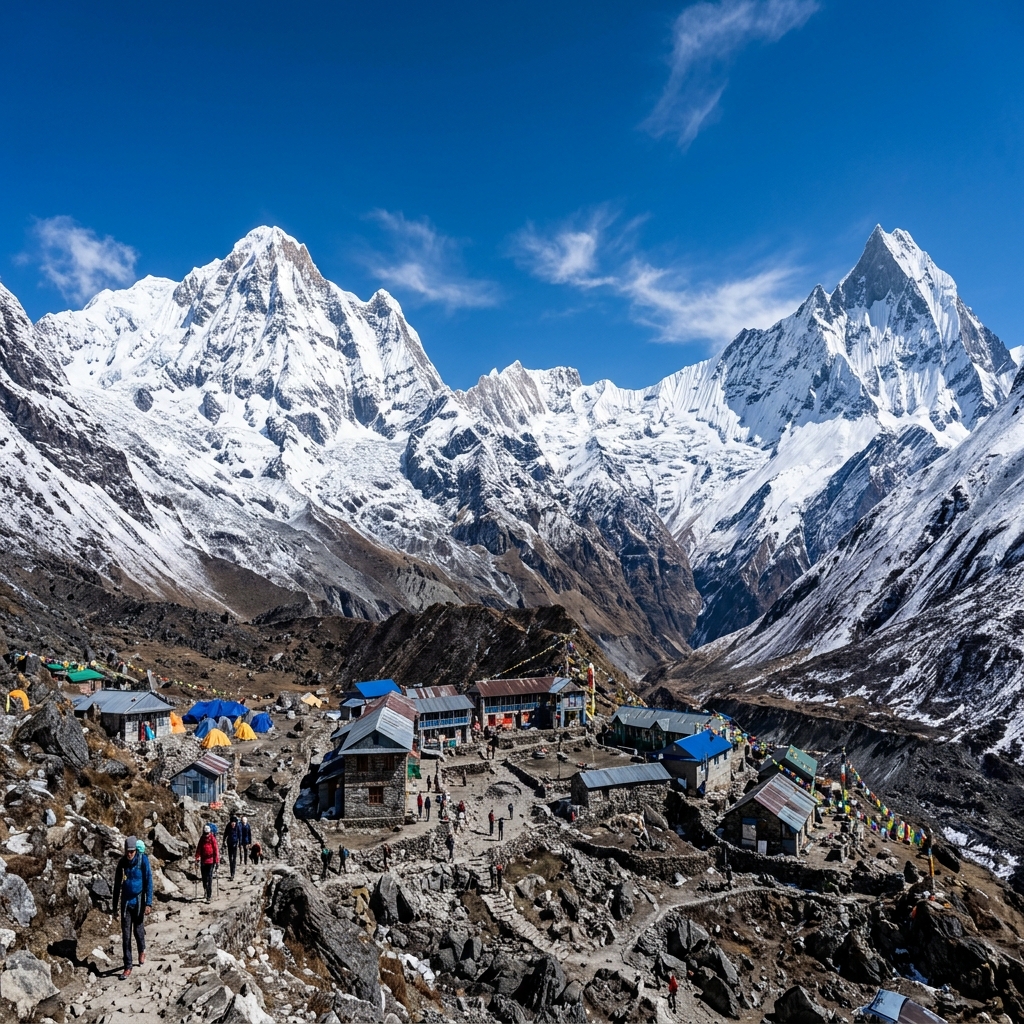
On Day 4 of my Annapurna Base Camp trek, my knees gave out on the stone steps above Chhomrong. A porter named Pemba slowed his pace to match mine without a word. By the time we reached Sinuwa, he had told me more about courage than any mountain view ever could.
The Man Behind the Basket
Pemba Tamang was twenty-two years old, built narrow and wiry, and carried a wicker doko strapped across his forehead loaded with two trekkers' duffels — close to 35 kilograms — while I struggled with a 6 kg daypack. He wore rubber sandals on the same rocky trail where I'd bought three pairs of "technical" boots before settling on one. When I offered him my trekking poles, he laughed, genuinely amused, and kept walking.
He'd been porting since he was sixteen, sending most of his earnings home to Gorkha district, where his mother raised three younger siblings alone. This was his eleventh season. He knew every teahouse owner by name, every shortcut, every place the trail turned to ice after October. He also knew, with quiet precision, exactly how much weight his body could carry and how many days in a row it could do it before something broke.
- Nepal's porters legally carry a maximum of 25–30 kg under IPPG guidelines — many still carry more when agencies cut corners
- A trained porter can move at nearly double a trekker's pace, even overloaded
- Porter injuries and altitude illness are dramatically under-reported compared to client incidents
A Conversation on the Steps to Sinuwa
Pemba spoke enough English to ask where I was from, and enough patience to wait while I caught my breath every fifty steps. Somewhere past the halfway mark, I asked him why he did this work — the cold, the weight, the danger of it.
"For school," he said simply. He meant his siblings', not his own. His own schooling had ended at fourteen. He said it without bitterness, the way you'd mention the weather. It was, to him, simply the shape his life had taken, and he seemed more interested in whether my knee was improving than in my reaction to his answer.
What "Support Staff" Actually Means
It's easy, as a trekker, to see porters as background — a logistics line item, a name on a permit form. Spending four days genuinely alongside one changes that completely. Pemba carried the literal weight that let me experience the mountains at all. Every dal bhat I ate, every dry sleeping bag, every photo I took without a 35 kg load on my back existed because of people like him.
The Sherpa and porter community that keeps Nepal's trekking industry running rarely appears in the postcards. But talk to enough guides and porters, and a pattern emerges: pride in the work, deep knowledge of the mountains passed down through families, and an expectation — quiet but real — that trekkers understand what's actually being carried up that trail.
How to Actually Support Your Porter
- ✓ Book only with agencies that are signatories of the International Porter Protection Group (IPPG) guidelines
- ✓ Confirm your porter has proper clothing, footwear, and insurance — ask your agency directly, don't assume
- ✓ Tip fairly: the standard is roughly USD 8–12/day per porter, given directly at trek's end
- ✓ Learn your porter's name and use it — it costs nothing and changes the whole dynamic of the trek
- ✓ Never ask a porter to carry more than the recommended weight limit, even if they agree to it
The Summit That Mattered Most
I reached Annapurna Base Camp on Day 6, and the view was everything the brochures promised. But the moment I actually remember, the one I tell people about, is Pemba adjusting his basket strap on the steps to Sinuwa, waiting for a stranger's knee to cooperate, in no hurry at all. TerraBlaze works exclusively with IPPG-registered porter teams — not because it's good marketing, but because the people carrying our clients' journeys deserve exactly that kind of respect back.
Ready to Hit the Trail?
Our expert guides craft personalized itineraries to match your pace, fitness, and budget.