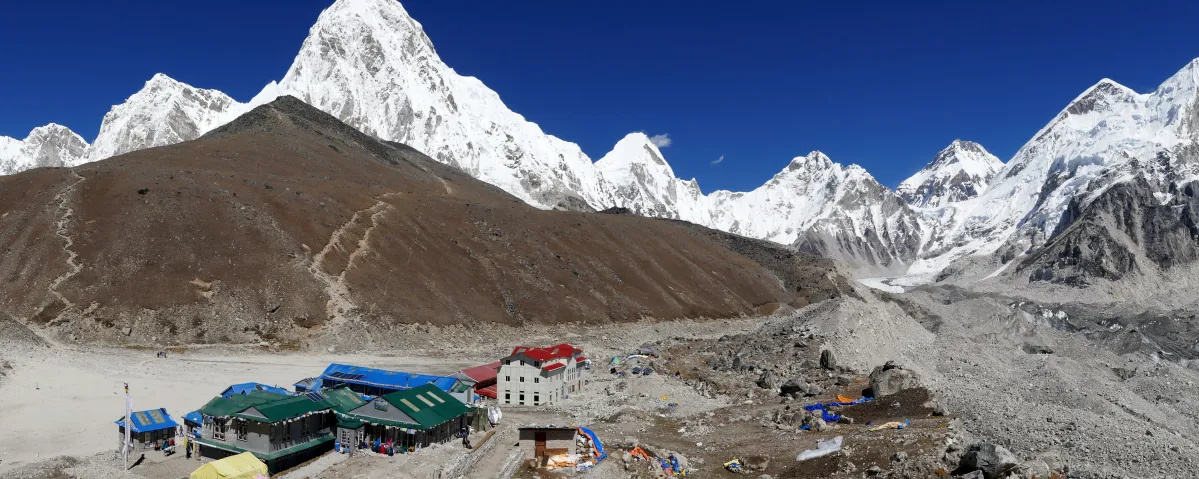
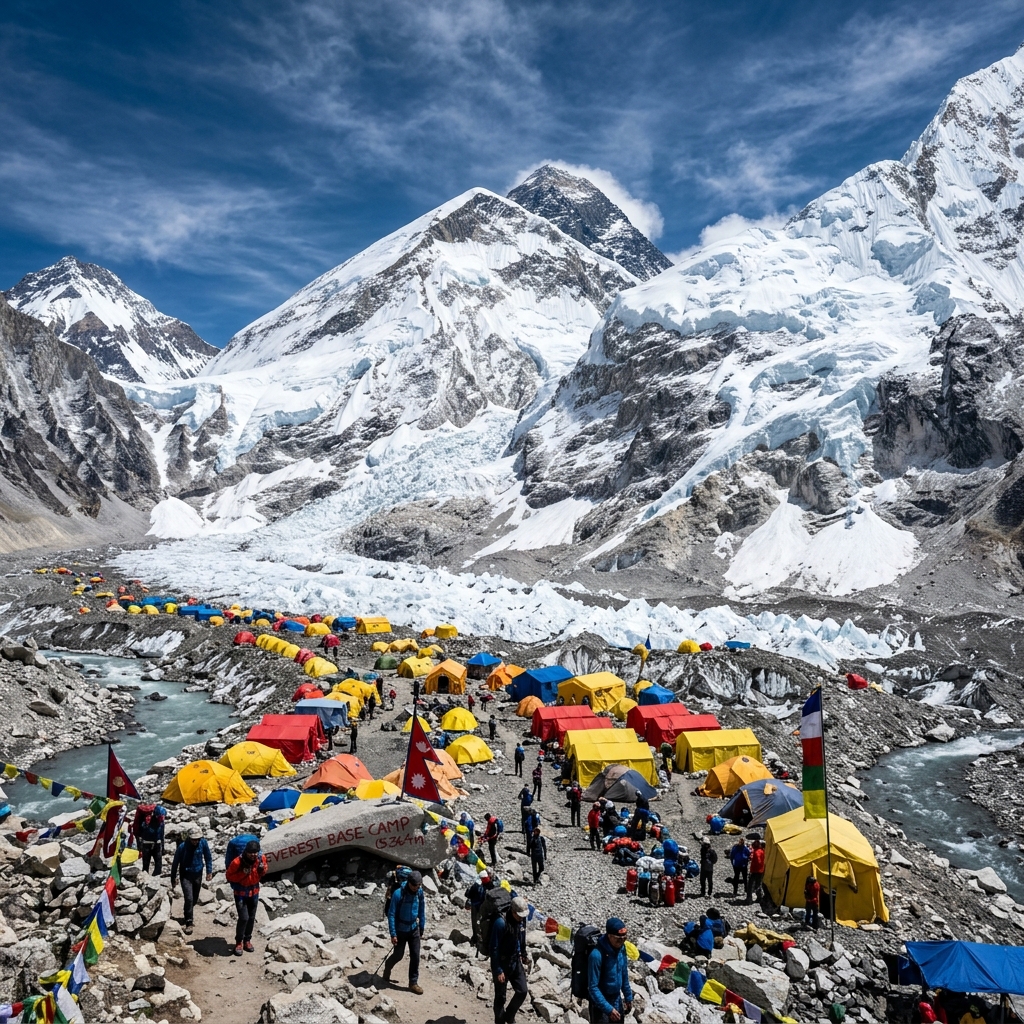
Expedition tents on the glacier at Everest Base Camp beneath the Khumbu Icefall
Khumbu, Nepal

Home Expeditions Over 8000 Meters

Everest Expedition

50–55 Days 8,848 m Extreme Bookings Open

Duration 50–55 Days
Summit Altitude 8,848 m
Best Season Spring (Apr–May)
Route South Col route from Nepal
The highest point on Earth

Expedition Overview

Everest needs no introduction, but it does need respect. From base camp the route threads the Khumbu Icefall in the cold hours before dawn, opens into the Western Cwm, climbs the blue ice of the Lhotse Face to the South Col at 7,900 m and finishes with a long night on the summit ridge past the Hillary Step. It is not the most technical of the 8000ers, but it is the longest sustained effort of them all: six to seven weeks on the mountain, three or four acclimatization rotations, and a summit day that begins at ten at night and may not end until the following afternoon.

TerraBlaze runs this expedition end to end: permits and royalties, the approach, a fully staffed base camp, the high-altitude team fixing and stocking the route, daily forecasting and an evacuation plan filed before you land. You bring the fitness and the experience — we handle everything else.

  • Route: South Col route from Nepal — 4 high camps above Everest Base Camp (5,364 m)
  • Season: Spring (Apr–May), when this face offers its most reliable summit windows
  • Experience: Previous 7000m or 8000m summit experience required
  • Oxygen: Bottled oxygen and a personal climbing Sherpa included above base camp
Expedition tents on the glacier at Everest Base Camp beneath the Khumbu Icefall
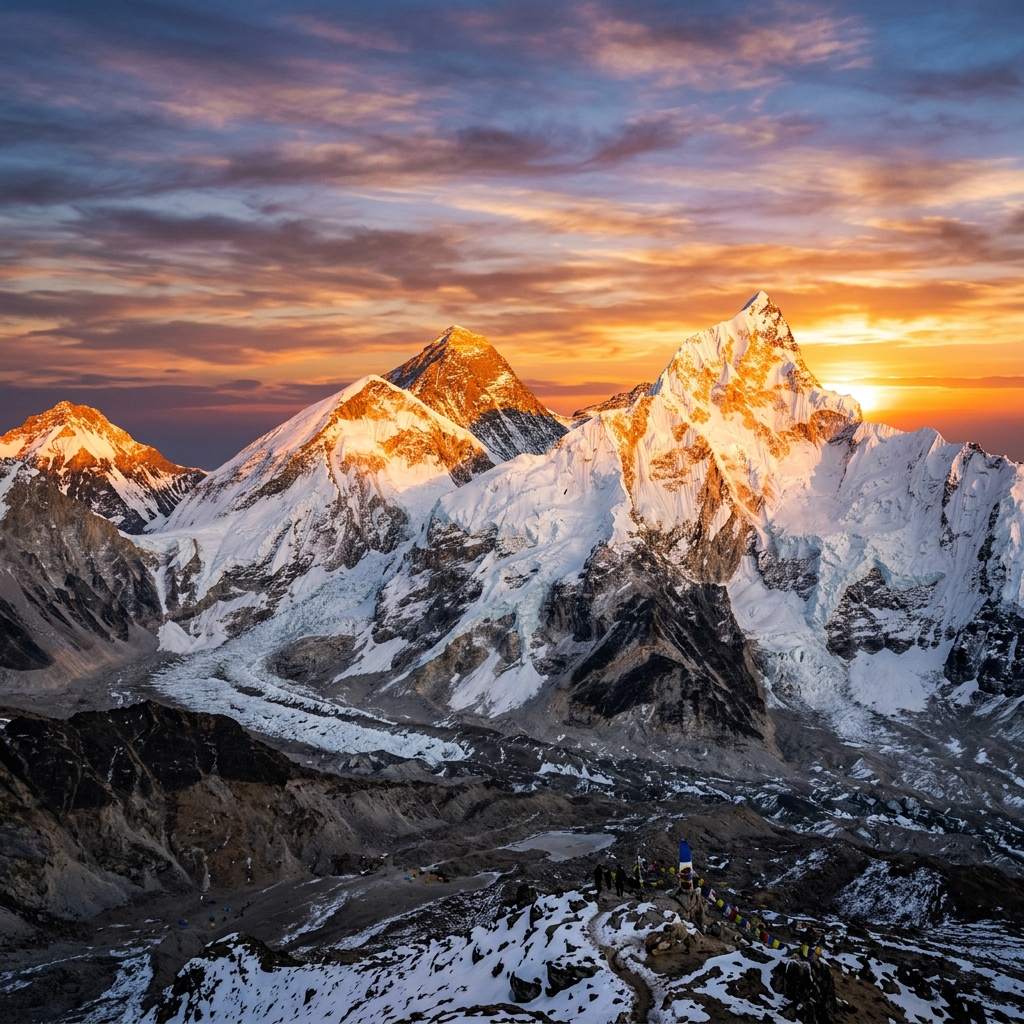
Mount Everest — tap to enlarge
What Defines This Climb

Expedition Highlights

Three things that set this permit apart — the mountain itself, and the support that gets you up it.

8,848 m

The South Col Route

The line Hillary and Tenzing finished in 1953, climbed today with fixed lines, four high camps and a full Sherpa team behind you.

  • Khumbu Icefall crossed on ladders set by the Icefall Doctors
  • Camp 2 in the Western Cwm as the expedition's forward base
  • Summit night from the South Col via the Balcony and Hillary Step
Sherpa Team

Full High-Altitude Support

A personal climbing Sherpa, fixed lines on the technical ground and a stocked high-camp chain from the moment you leave base camp.

  • One climbing Sherpa per member on summit rotation
  • Rope fixing handled by our own high-altitude team
  • Tents, stoves and fuel pre-positioned at every camp
Daily Forecasts

Weather Windows & Safety

Dedicated forecasting through the whole expedition, a doctor-supervised medical kit at base camp and a rescue plan filed before you arrive.

  • Independent summit-window forecasting each morning
  • Gamow bag, oxygen and full medical kit at base camp
  • Helicopter evacuation coordinated within the permitted ceiling
How the Expedition Runs

Expedition Phases

Expeditions are planned in phases rather than fixed days — the mountain and the forecast decide the exact schedule. Every confirmed booking gets a full dated itinerary before departure.

Phase 1

Arrival, Briefing & Gear Check

  • Hotel • Permits • Kit check

You are met on landing and taken to your hotel in Kathmandu.

More detailsShow less

Over the next days we complete the government briefing, finalise permits, and go through your personal equipment item by item with your expedition leader. Anything missing can still be bought or hired at this point.

Phase 2

Approach to Base Camp

  • Approach • Acclimatization

The team travels to the mountain by a flight to Lukla and the classic nine-day trek through Namche Bazaar and Tengboche to base camp on the Khumbu Glacier.

More detailsShow less

The approach is paced for acclimatization rather than speed — the days are deliberately short, and the altitude gain is controlled.

Phase 3

Base Camp & Puja

  • Base camp • Skills refresher

We establish Everest Base Camp (5,364 m) with dining, kitchen, communication and medical tents.

More detailsShow less

The Sherpa team holds the traditional puja ceremony before anyone steps onto the mountain, and we run refresher sessions on fixed-line technique, crevasse rescue and oxygen systems.

Phase 4

Acclimatization Rotations

  • 4 high camps • Rotations

The heart of the expedition. The team makes progressive rotations up to the higher camps — 4 camps are established on this route — sleeping high and returning to base camp to recover between each cycle.

More detailsShow less

Meanwhile the high-altitude team fixes rope and stocks the upper mountain.

Phase 5

Summit Push

  • Summit day • 8,848 m

When the forecast gives a usable window, the team moves back up the mountain camp by camp for the summit bid on Mount Everest (8,848 m) via the South Col route from Nepal.

More detailsShow less

Bottled oxygen and a personal climbing Sherpa included above base camp.

Phase 6

Descent, Clean-Up & Return

  • Descent • Certificate

After the summit the team descends to base camp, strips the high camps and carries everything off the mountain — we leave nothing behind.

More detailsShow less

The return journey retraces the approach, ending with a celebration dinner and your summit certificate.

Clear From the Start

What Your Quote Covers

The same transparent structure we use on every trek — you know exactly what is in the number before you commit to anything.

Included

  • All climbing and national park permits, royalties and liaison officer fees
  • Airport transfers and hotel nights in the gateway city before and after the climb
  • Full board at base camp — cook, kitchen crew, dining and communication tents
  • Group climbing equipment: ropes, ice screws, snow bars, anchors and high-camp tents
  • Personal climbing Sherpa or guide as specified for the peak
  • Porters, pack animals or cargo flights for the approach and the return
  • Base camp medical kit, pulse oximeters, Gamow bag and emergency oxygen
  • Daily weather forecasting and satellite communication throughout the expedition
  • Government-issued summit certificate on successful completion

Not Included

  • International flights and the entry visa for Nepal, Pakistan or China
  • Personal climbing gear — boots, down suit, harness, axe, crampons and layers
  • Travel and rescue insurance covering helicopter evacuation at the climbing altitude
  • Meals and accommodation in the gateway city beyond the nights listed
  • Summit bonus for your climbing Sherpa and tips for the base camp crew
  • Personal expenses, extra oxygen bottles and any charge arising from an early return
Climb With Confidence

How We Look After You

From the day you land until the day the last load comes off the mountain, the logistics and the safety net are ours.

Climber-Led, Not Desk-Led

Every expedition is run by staff who have stood on high-altitude summits themselves

Permits & Paperwork

Royalties, liaison officers and restricted-area permits handled end to end

Acclimatization Built In

Rotation schedules paced to the mountain, never to the calendar

Base Camp That Works

Heated dining tent, fresh food, charging and comms for the whole expedition

Oxygen & Medical Cover

Stocked medical tent, pulse oximetry and an evacuation plan filed in advance

Sherpa Team You Can Name

The same high-altitude climbers season after season, fairly paid and insured

24/7 Expedition Desk

A Kathmandu control point in daily contact with your base camp manager

No Hidden Charges

One transparent quote — permits, logistics and support staff all included

"Everest is not climbed in a day. It is climbed in six weeks of patience, and then one very long night."

— Mount Everest, 8,848 m

Good to Know

Frequently Asked Questions

Previous 7000m or 8000m summit experience required. We ask every applicant for a short climbing resume before confirming a place, and we will tell you honestly if we think a different peak would serve you better this season.
We run this expedition in Spring (Apr–May). That is when the South Col route from Nepal offers the most stable conditions and the most reliable summit windows. Departures outside the listed season can sometimes be arranged for private teams, but we will be candid with you about the reduced chance of success.
Expedition pricing depends on the season, the size of the team, the level of Sherpa and oxygen support you want and the current government royalty. Email us at booking@terrablazeadventure.com or send the form on this page and we will reply with a full written quote, itemised line by line, within 24 hours.
A policy that explicitly covers mountaineering at the altitude of your peak, including helicopter search and rescue plus repatriation. Standard trekking cover is not enough. We will check your certificate before departure and tell you if the ceiling is too low.
No responsible operator guarantees a summit — weather, snow conditions and your own body all get a vote. Our guides are instructed to turn a climber around whenever the risk stops being acceptable, and that decision is never held against you. There is no refund for an early descent, but your support team stays with you the whole way down.
Yes. Many climbers add an acclimatization trek beforehand or a few recovery days afterwards. Tell us what you have in mind and we will build it into the same quote.
Reserve Your Place

Plan Your Everest Expedition

Send us your climbing history and preferred season. We reply within 24 hours with a written, itemised quote — and an honest view on whether this is the right peak for you right now.

Licensed & Trusted

Fully licensed Nepali agency — Regd No: 125496/078/079

Fast Response

Personal reply within 24 hours — no bots, no call centers

Honest Assessment

We will tell you if a different peak suits your experience better

Request Your Booking

Everest Expedition50–55 Days • Free quote within 24 hours

Submitting opens a pre-filled email — no payment is taken now.

Book Now